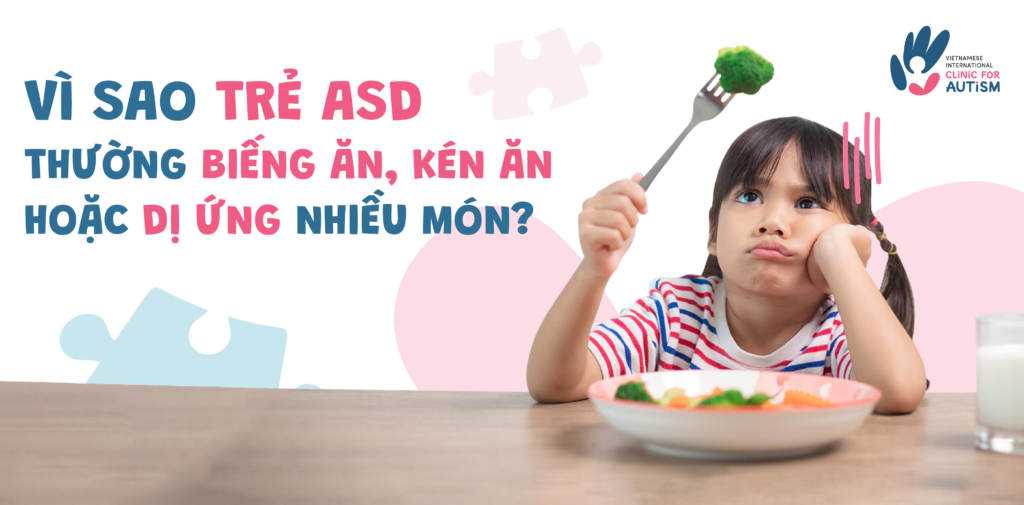
At VICA – the International Center for Early Diagnosis & Intervention of Autism Spectrum Disorder, we frequently receive heartfelt concerns from parents: “My child only eats a few familiar foods,” “My child pushes away any unfamiliar food,” “My child vomits when trying new foods,” or “My child seems to be allergic to too many types of food.”
In reality, eating problems in children with ASD are not simply about picky eating, but are often related to the specific developmental characteristics of children on the autism spectrum.
 Sensory Processing Differences
Most children with ASD have differences in sensory processing. This directly affects eating habits, for example:
– Sensitive to smells (fishy smells, smells of boiled vegetables, smells of spices)
– Discomfort with food texture (soft, mushy, slimy, lumpy)
– Strong reaction to color or presentation
– Cannot tolerate the feeling of food mixed together.
For children, trying a new food can sometimes feel like facing a “sensory overload experience,” rather than them deliberately resisting it.
 The need for stability and repeatability.
Children on the autism spectrum often feel safe when things are familiar and predictable. Therefore:
– Your child may only eat one brand of milk.
– Only one type of food cut is acceptable.
– Only eat when using familiar bowls and spoons.
Small changes in eating habits can sometimes cause children anxiety, leading them to refuse food.
 Difficulties with oral motor skills – chewing – swallowing
Some children with ASD will have difficulties with eating, such as:
– Oral muscle coordination
– Chew foods with varying degrees of hardness.
– Adjust biting and chewing forces
This causes children to avoid foods that require thorough chewing or have complex textures.
 Digestive problems and food allergies
Children with ASD have a higher rate of digestive problems compared to children with typical development. Some children may:
– Lactose intolerance
– Gluten sensitivity
– Easily causes bloating, constipation, and abdominal pain.
However, not all cases of picky eating are true allergies. Arbitrarily eliminating too many food groups without professional assessment can lead to nutritional deficiencies.
 So what should parents do?
At VICA – the International Center for Early Diagnosis & Intervention of Autism Spectrum Disorder, we always approach the issue of nutrition from a multifaceted perspective:
 Assessing sensory factors Observe chewing and swallowing skills. Consult with a nutritionist when needed. Applying ESDM and natural behavioral intervention (NDBI) methods to gradually expand the food portfolio.
We don’t force children to eat, but create a safe environment and gradually help them:
– Getting acquainted with food through play, such as cooking classes.
Touch, smell, and observe before tasting.
– Gradually increase the level of acceptance in a gentle manner.
 Most importantly:
Picky eating in children with ASD is not the child’s fault, nor is it due to parental indulgence. It’s a sign that the child needs proper understanding. By understanding the underlying causes of the behavior, we can provide appropriate support – so that each meal is no longer a “battle,” but an opportunity for connection and growth.
 Parents may need more in-depth advice on how to help their children overcome picky eating or explore suitable intervention programs. The VICA team is always ready to support your family.